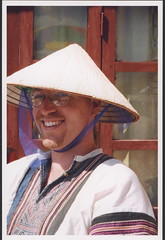
Hanoi has no shortage of places to get a haircut. In fact, the place involved really does seem irrelevant. This is because the barber often just carries or rolls the tools of the trade to his favorite spot on the sidewalk and sets up shop. Even at night when the sidewalks are empty you can see where the barbers hang out by the piles of hair swept off the curb. My old barber has disappeared, gone around the corner or somewhere without leaving a forwarding address, so I went to a new one the other day.
Sitting on a rickety wooden chair, with its own little awning in case of rain I guess, I look at the mirror hanging crookedly on the wall in front of me. In it, I watch all the passers-by walk behind me, amused to see how many of them do a double-take, stopping just to make sure it really is a foreigner (who has clearly gone far too long without a trim) getting done up at their local barber.
The barber, upon hearing the first hint of a Vietnamese word from me, suddenly pulls some papers out of his wooden tackle-box full of scissors and razors, saying "You should try to read this, can you read this?" It is poetry, his poetry, written in the implausibly neat, rounded script of someone who actually studied penmanship. Poems about spring, about Hanoi, about … Russian women!? After some pronunciation corrections and instruction on how to properly read metered poetry in Vietnamese, my barber is mostly satisfied with my recitation.
Eventually, he gets down to business and cuts the hair. It’s a fast haircut; he’s obviously had lots of practice at barbering, in between writing poetry. A neighbor and friend of the barber stops by to chat. He teaches at the local university, and keeps trying out what I gather is Vietnamese-accented German on me. Sadly, I have no skills in speaking German, so that conversation doesn’t go too far.
“I wish I could grow a beard,” the barber says. He is impressed with my beard (a sort of experiment that’s gone hand in hand with going too long without a haircut). He’s got the classic Asian look going on – smooth clean skin with half a dozen 3 inch long hairs sprouting out of a mole on his chin. He tells me my beard makes me look like somebody, and it takes me awhile to make out exactly who he is talking about.
Engels, Friedrich Engels, the co-father, along with Karl Marx, of Communist Theory. So, hmm, that’s interesting. In spite of living in Hanoi, I have no recollection of what the chins of the fathers of Communism looked like. I have since looked up pictures of Mr. Engels, and I can assure you with utmost sincerity that my beard looks nothing like that. It would take years in a cold climate to get me to that point!!

WAH!