Showing posts with label books. Show all posts

Sunday, May 22, 2011

Pebbles

The Education of a British-Protected Child
Chinua Achebe

A collection of essays, speeches and thoughts from the author of Things Fall Apart, this book somehow reminds me of the rambling, memoir-esque conversations you have here when drinking sugar cane juice in the countryside and grandpa sits down to tell stories.
Igbo proverb: “He who will hold another down in the mud must stay in the mud to keep him down.”

Eat Pray Love
Elizabeth Gilbert
Not my favorite, had I noticed that this book came with the “Now a major motion picture” sticker I might not have bought it. Anyway, it is the story of a woman’s year-long sojourn through Italy, India and Indonesia. Actually, it is the story of the author, the travel aspect is backdrop, which I suppose is the way it happened. The story is well written and often funny, but the self-centeredness of it was hard for me to get past…

Active Liberty: Interpreting Our Democratic Constitution
Stephen Breyer
A dry but very accessible and concise presentation of Justice Breyer’s approach to the constitution.

Why School? Reclaiming Education for All of Us
Mike Rose
An impassioned defense of the ideals behind the American experiment with public education.

Granny D: You’re Never Too Old to Raise Little Hell
Doris Haddock/Dennis Burke
“Small towns make up for their lack of people by having everybody be more interesting.”
‘Granny D’ an eighty-nine year old lady from small town New England walks across the US to raise awareness about campaign finance reform. As you might expect from such an eighty-nine year old, the story is full of humor and common sense.
Regarding roadside attractions that only happen on two-lane highways: “A good deal of fun died with Eisenhower’s interstate highway program, which he copied from the Nazis.”
“What is the point of being in Arizona, I decided, if you cannot be a rodeo queen?”

Saturday, November 06, 2010

Bricks in the Wall

Iran Awakening
Shirin Ebadi
The gripping story of a determined, intellectual Iranian woman’s experiences, from her childhood under the Shah, as a university student during the Iranian revolution, and her work as a legal professional and eventually a leading human rights advocate within Iran.

Three Cups of Tea: One Man’s Mission to Promote Peace… One School at a Time
Greg Mortenson, David Oliver Relin
Mountaineer-turned-development worker Greg Mortenson dives into life in northern Pakistan with an unconventional approach that gets things done. And he drinks tea too, I can dig that!

Red Tape and White Knuckles
Lois Pryce
This woman rides her motorcycle from London to Cape Town. And has a sense of humor writing about it. I liked this book because it is ‘just’ a story about the journey, it’s not a history lesson or political analysis of the places she goes through and it doesn’t try to be. A frank account of what travel in Africa is like, or at least what it was like for her.

The Boy Who Harnessed the Wind
William Kamkwamba, Brian Mealer
William Kamkwamba grew up in a small village in Malawi. Through a combination of curiosity, access to an old science textbook, and frustration at being unable to continue school, he built a windmill next to his house to power electric lights in the evening. With this as evidence of both determination and ability, he is able to return to school, eventually to university, and of course, write a book about it all.

Thursday, February 18, 2010

New to my Shelf

When Broken Glass Floats: Growing Up Under the Khmer Rouge
Chanrithy Him

A memoir from Cambodia, this story is well written and, as you would expect in a story of genocide, sometimes painful to read. The author grew up in a relatively well-educated family in Phnom Penh, whose life was turned upside-down when the Khmer Rouge came to power in 1975. The book is full of dignity and humanity, standing witness to the appalling lack of either from those in power at that time.

Snow on the Moon
Keith Heller

I picked up this book quite randomly at a used bookstore - there is one bookstore in Hanoi with used English books which I found long long ago J . A novel loosely set in a small town in Spain late in World War II, it is written in a style which reminded me of so many English literature ‘classics’ that I’ve read. The impression was strengthened, I think, by the actual book – a high quality paperback that is dog-eared from use and brown from humidity. The story is snowy and mysterious, the strength of a child’s prescient naiveté playing against an adult’s hesitant willingness to be involved.

Catch 22
Joseph Heller
I guess this is one of those classics that I never got to until recently. I thoroughly enjoyed it, and spent a great deal of time laughing while I was reading this book. The story is of a bomber pilot at the end of World War II. The story, however, is in the telling of it. The satire is sharp and irresistible, it’s just been too long since I read something which made me laugh and think at the same time!

The God of Small Things
Arundhati Roy
A beautifully woven story of complex characters, Arundhati Roy’s first novel is transfixing in detail and inexorable in tragedy. It is a novel truly deserving all the praise heaped on it. I’m not sure how it happened that I didn’t read it sooner.

Dragon Fighter: One Woman’s Epic Struggle for Peace with China
Rebiya Kadeer
The endless expanse of the Gobi Desert, paradoxically ancient yet fragile and crumbling remains of Silk Road cities, Kashgar’s incredible carpet bazaar, the cool underground streams of Turpan on a sunny afternoon, a blood-stirring drum and fife sidewalk performance by local boys in Urumqi, the friendly welcoming smiles of new acquaintances, long hours on uncharacteristically (for China) empty trains; these are my memories of Xinjiang, western China. Rebiya Kadeer’s memoir recounts her experiences growing up and her life as a mother, entrepreneur, big business owner, government representative and, eventually, prisoner, in Xinjiang, and finally as a Uyghur activist from the other side of the world. It is an inspiring story of fortitude.

China in Africa
Chris Alden
A technical and analytical look at the rapidly growing influence of China in Africa, economic and otherwise, this book is short and full of data. I appreciate the academic approach to this topic; it seems that most of what I come across to read on this theme, from my Western-centric media consumption habit, is in passing, shallow and frequently inflammatory. Alden presents a well-supported overview of China’s impacts on Africa, as well as exploring the various motivations for this natural expansion of influence and the potential ramifications both for Africans and Chinese.

Wolf Totem
Jiang Rong
This is a truly fascinating novel set in China’s grasslands of Inner Mongolia during the Cultural Revolution. A Chinese student travels to the grasslands to live among the Mongol herdsmen to learn about them and, as usually happens in such cases, to learn about himself. It was written and published in Chinese before being translated, and features a great many philosophical discourses ranging from the respective characteristics of nomadic vs. agricultural societies, the Han Chinese relationship to ethnic minority groups, the impact of development and migration on nature, to, perhaps in the most grandiose interpretation, a general critique of the ‘Chinese character’. It is a very compelling read. While sometimes veering into an overly idealistic view of nomadic life or presenting a simplistically monolithic view of the above-mentioned ‘Chinese character’ (from an outsiders perspective, the diversity of China seems more prominent to me), the fable-like tone of the writing makes it a good read regardless of one’s interpretation.

Friday, October 02, 2009

I Carry Around Too Many Books ...

The House on Dream Street – Dana Sachs

Stories of an American in Hanoi, from back in the day. “Back in the day” here meaning the 90’s, although similar stories, I have to say, are told by most foreigners who have been here any length of time, about how things were so different “back in the day” when they first arrived here, whenever that was. Anyway, it’s a cool story, for everyone who can’t come visit me and experience the place for yourself (which is, hmm lets see, EVERYBODY, except that one cousin), the least you can do is read a book about it!

Lakota Woman – Mary Crow Dog

Good book, made even more fascinating for me because the author is from Rosebud Reservation, next door to Pine Ridge Reservation where I spent some time "back in the day" :). The kind of things I saw there, and the stories in this book, seem to belong to the ‘rest of the world’ more than to the America that I grew up in. In any case, the book is worth a read, more passionate than articulate, but all the more revealing for that.

Aama in America – Broughton Coburn

The story of an old woman from a Nepali village, travelling in America with a former peace corps volunteer who had become part of her family, so to speak. Shifting plots make the book less than a straight read, but it is full of great quotes, funny and true-to-life both at once.

Unaccustomed Earth – Jhumpa Lahiri

Short stories, it’s been awhile since I read short stories. I like them, and I like these. Its polished writing, but you don’t notice that until afterwards J

Falling Leaves: The Memoir of an Unwanted Chinese Daughter – Adeline Yen Mah

The subtitle pretty much explains this book. Although I started it expecting the same kind of story that I’ve read a hundred times about growing up in 20th Century China, I was eventually pulled into the story, and it became a good read. And, in case I hadn’t thought about it recently, which I had, it reminded me of what a phenomenally cool family I have!

Tuesday, April 28, 2009

Watching and Reading

Reading the recent news stories about Sri Lanka, I was reminded of a film I saw not too long ago, The Forsaken Land (directed by Vimukthi Jarasundara). Although it is set in the context of the military conflict in Sri Lanka, the dominant impression I had of the film was of silence. I really liked that about it, the silence and the simplicity with which the characters are presented laid bare their common humanity, something too often lacking in movies from war-torn places.

Another film which gets a few stars from me is Couscous, the story of a North African immigrant family in the south of France. Humorous and honest – those two things always go far!


And from my reading list Dreams from my Father by Barack Obama was a good read. In part, I think, because there was no particularly presidential tone about the writing – it was written before the whole running for president thing came up. It is more simply the discovery and coming to terms with a unique family history, or perhaps it is not so unique a history, in any case it’s a good story and, you know, it’s always good to know at least a little something about the president!

The Old Patagonian Express by Paul Theroux is a classic old-school travel memoir, about taking the train from Boston to Patagonia, the southern tip of South America. I enjoyed it, as I have most everything I’ve read from Paul Theroux. Although it is quite old (aside from being old-school!), there are a great many things about travel that don’t change that much between places and decades!

Noah Adams, of NPR ‘fame’, wrote a book called Piano Lessons, on the experience of, well, taking piano lessons. Well written and a quick read, it somehow still failed to inspire me to go out and buy a piano… Perhaps that has more to do with the relative immobility of your average piano compared to, say, me, not to mention the price. I guess pianos are just like that!

Finally, back to Vietnam, Last Night I Dreamed of Peace is the personal diary of Dr. Dang Thuy Tram, a young woman from Hanoi who was head of a medical unit for the North Vietnamese Army during the war, until she was killed. This book was kind of an instant sensation when it was first published in Vietnamese, presumably because it is a strictly personal story from the war period, a perspective probably not often used when young Vietnamese learn about the war. Again, this book is a personal diary, not a history of the war, and, to the extent that you can glean broad themes from a diary, it says more about the human spirit than it does about war.

Saturday, February 14, 2009

Châu Phi Books

Truly the most comprehensive book on Africa I've ever read, The Fate of Africa: A History of Fifty Years of Independence by Martin Meredith, takes you through post-colonial African history in detail. It covers pretty much the whole continent. The unique thing about the book is its structure. It does not follow a single country or even a region, chronologically going through history. Instead it follows a sort of thematic structure, simultaneously looking at different places where similar or related events happened. While this can make the book confusing if you set it aside for a couple weeks and then jump back into it, it is also a real strength in helping the reader see historical events in their contemporary context. This is particularly important in a place where state boundaries are frequently arbitrary, not accurately reflecting geographic features or ethnic groupings. So I liked the book a lot, but it took me a couple months to slog through it!

The Translator: A Tribesman's Memoir of Darfur by Daoud Hari is a personal memoir of the experiences of a Darfur native working as a translator and guide for journalists and aid workers. I loved the storytelling tone of this book, his voice is consistently respectful and often humourous, even in the face of the atrocities happening in his homeland. It is this kind of story that gives a human perspective to the news articles. And speaking of news articles, the events in Darfur are of course on-going, and in something new under International Law, the ICC has just issued an arrest warrent against Sudan's current President Omar Hassan al-Bashir. Clearly that will not solve the problem, indeed it may complicate the solving of the problem, but at least it adds some personal responsibility into the equation. Anyway, the book is a great read, like three days, no slogging required!

Thursday, February 05, 2009

Me Staying in One Place

Having returned from Kenya and been back in Ho Chi Minh City for a good four days now, I've been sort of reading the paper and, you know, thinking about going somewhere else... I mean really, shouldn't I take advantage of my current lack of work and make it an opportunity to go somewhere? It is a worn bit of logic that has taken me many places, I guess.

Given that state of mind, I was reading an article about Laos. Incidentally, about Bill Lair, who was the subject of a quite good book which I read long, long ago, called Shooting at the Moon: The Story of America's Clandestine War in Laos. Which was reminding me, not of war history and all that, but of the very fun time I had in Laos when I was there. So on that note, let me just announce to everybody that I'm still in Ho Chi Minh and I haven't gone anywhere else.

Yet.

A film I want to see: Pray the Devil Back to Hell. A documentary from Liberia under Charles Taylor. I won't say anything more about it cause that is really all I know. Just thought I'd say I want to see it, so if anybody has a chance to see it, do that and let me know if it's worth buying!

And speaking of films, just before I left for Kenya I saw a Vietnamese film that is truly worth seeing, Owl and the Sparrow. It is a bit sappy at times, the final scene leaves you in a saccharine haze obscuring the authenticity developed through the film, but that last scene stands out precisely because the rest of the film is so well done. The colors are vibrant, the filming is close and intimate. Which is a nice way of saying that it effectively captures the way life is in the middle of Saigon, claustrophobic and frenetic while, at the same time, strangely placid. Check it out!

Sunday, March 16, 2008

Những quyển sách mùa đông

No Man’s Land, Duong Thu Huong
****
This epic novel revolves around a highland village in post-war Vietnam. The strength of this book is in its characters, well-crafted enough that you eventually see each of them, even in their competing roles within the plot, as you would a friend. By virtue of familiarity with their experiences as well as their aspirations and ideals, you come to identify with all three main characters, and thus are brought face to face with the classic Confucian conundrum of the story (a tragedy of sorts), where the allegiances which are designed to bind you into society are twisted to the task of tearing you apart. Truly a book you can get caught up in.

Brief Encounters with Che Guevara, Ben Fountain
***
A collection of short stories that takes you all over the world, this book is exceptional in its portrayal of Americans in international settings. I was impressed with it – the characters and settings are real in their complexity and refusal to be ‘boxed’ or explained. In spite of all the time I spend reading about (or dreaming up) precisely that – explanations of the world that makes sense to my head – it is only the ideas and places most opaque to me that are able to hold my attention. Which is why I like the book, it’s about people who are out of place!

The Irresistible Revolution, Shane Claiborne
**
A call of sorts for Christian communalism, this book is at times inspiring in its real, simple, logical application of spiritual concepts that are often religiously clichéd beyond recognition. There are a lot of ideas here, about the value of community, about living reasonably in a rabidly materialistic world (well, America, at least), about treating people always and first as simply people like yourself, which I very much agree with and have a great deal of respect for. That said, this particular revolution would have been a bit more irresistible to me had he expanded the motivational basis for the appeal to a simple and more basic human level. Inspiration for living with decency and respect for others can come from any number of sources.

Perfume Dreams, Andrew Lam
**
A collection of essays relating to the Vietnamese-American experience, this book is well-written but I found the structure (or lack of) not very conducive for creating a big picture. A little fractured, maybe that was the intent though.

The American Soul, Jacob Needleman
****
Needleman’s goal here is to, in his words, ‘re-mythologize’ the idea of America, by looking at the ideals and characters of some American historical figures, and how the actions of America through history have reflected, or rejected, those ideals. The character studies on Washington, Jefferson and Lincoln are explicitly focused on the ideals of the men, as such they do not aim so much to examine their lives as to explore how their ideals are relevant to America today. The most fascinating part of the book looks at American experiences in direct opposition to the stated ideals of the nation, like the dehumanizing of the American Indian, and slavery and racism. He also has a small section on Vietnam, although to be clear it is on ‘the Vietnam experience’ within America, with little relation to Vietnam itself. After recounting the story of Conrad Beissel and the Ephrata Cloister, he moves on to Walt Whitman. All in all I very much enjoyed this book, it is more spiritual philosophy than history, and is a bit more rooted than philosophy often is.

Sunday, November 25, 2007

My Armchair Travels

Actually, I don’t have an armchair. But if I did, I would certainly use it! I am back in Hanoi, for anybody who didn’t know, wandering in small circles as usual. Re-entry has been fairly smooth – I have the same room, same motorbike, same ‘job’ and am studying the same language. Phở is still good for breakfast, and better here than on Fruitville Pike, no surprise there!

Being something less than half employed and being something less than a model (laborious!) student, I spend inordinate amounts of time soaking up caffeine in one form or another and reading books (which is really an armchair sort of activity, unless you happen not have an armchair - in my case it is a child-sized-plastic-lawn-furniture activity, as that is what sidewalk cafes here have to sit on). So, at the risk of flooding my blog with things other people have said, here are some comments and notable quotes from my latest stack of books.

* * * * *

Mountains Beyond Mountains, by Tracy Kidder, describes the life and work of Dr Paul Farmer. Dr Farmer’s primary work is in a clinic in rural Haiti, although he is also part of a great many other projects in public health all over the place. This book is really good. While I know next to nothing about public health issues, the way you can see idealism (naiveté, in another word) put to practical use here is a little inspiring to me. It is a comprehensive perspective on life that sort of reminds me of all the opportunities that are out there, even for me in my type Z personality world…

* * * * *

A Concise Chinese-English Dictionary for Lovers, by Xiaolu Guo, is one very funny and insightful novel, on language and cross-cultural experience and relationships. It is the story of a Chinese student who goes to England for a year of study, and as the title suggests, it is primarily about the linguistic and cultural conundrums inherent in her relationship with her boyfriend there. The writing is in the voice of someone just learning English. You might think that I see enough fractured English already, being an editor, but the use of that simplistic yet direct and forceful style adds a lot to the story.

Chinese, we not having grammar. We saying things simple way. No verb-change usage, no tense differences, no gender changes. We bosses of our language. But, English language is boss of English user.

Every night I coming out Tottenham Hale tube station and walking home shivering. I scared to pass each single dark corner. In this place, crazy mans or sporty kids throwing stones to you or shouting to you without reasons. Also, the robbers robbing the peoples even poorer than them. In China, we believe “rob the rich to feed the poor.” But robbers here have no poetry.

I sit in pub alone, trying to feel involving in the conversation. It seem a place of middle-aged-mans culture. I smell a kind of dying, although it still struggling. While I sitting here, many singles, desperately mans coming up saying, “Hello darling.” But I not your darling. Where your darling? 7 o’clock in the evening, your darling must be cooking baked bean in orange sauce for you at home … Why not just go home spending time with your darling?

“You’ve invaded my privacy! You can’t do that!” First time, you shout to me, like a lion.
“What privacy? But we living together! No privacy if we are lovers!”
“Of course there is! Everybody has privacy!”
But why people need privacy? Why privacy so important? In China, every family live together, grandparents, parents, daughter, son, and their relatives too. Eat together and share everything, talk about everything. Privacy make people lonely. Privacy make family fallen apart.

We argue all the way back to home. Open the door, make a pot of tea, you start woover the floor again.
So noisy. It makes me headache immediately. The woover must be invented by mans. I sit on chair not let the big dragon swallow me and take out the Little Red Book from my drawer. There are some pages about womans and equal in Mao’s speech:
In order to build a great socialist society it is of the utmost importance to arouse the broad masses of women to join in productive activity. Men and women must receive equal pay for equal work in production.
This must be the original thoughts which became legend “womans hold up half of the sky” in China.

In Italy: Inside of taxi, so close, I can see his face clearly. He looks bit formal in his plain suit and black leather Made-in-Italy shoes. His hair is very few in the middle of his head. He seems sincerely but a little boring, if I can judge like that.
“So what do you do?” I ask.
“I am an avocado,” he replies.
“Avocado?” I am surprised to hear. Is a fruit also a job? “Please explain me,” I ask.
“If you are going to be put in prison you can hire me to help you in court,” he says.
“Ah… is like a lawyer?”
“Yes! Yes! Avocado is lawyer.”

You are cooking some obscure pie for me. It is called q-u-i-c-h-e. I have never seen if before. On the bag it says Even Real Men Eat Quiche. Quiche, q-u-i-c-h-e. I can’t believe it when I am swallowing this piece of shapeless hot stuff. Such an ambiguous piece of food. Totally formless. I wonder about what my parents would say if one day they come to this country, and they eat this. My mother probably will say: “It is like eating something from other people’s mouth.” And my father will say: “It must be left from earlier meal so they re-cook it but inside are already messed up.”
I will agree with my father: it is a piece of big mess indeed. You tell me it is actually from France. I don’t believe you. I think the English are too ashamed to acknowledge it is their food. So they say it is French to defend themself.

“You know, you never tell me things like this.” Now you get up from the bed. You must feel better.
“But you never really ask me. You never really pay attention to my culture. You English once took over Hong Kong so you probably heard of that we Chinese have 5,000 years of the greatest human civilization ever existed in the world… Our Chinese invented paper so your Shakespeare can write two thousand years later. Our Chinese invented gunpowder for you English and Americans to bomb Iraq. And our Chinese invented compass for you English to sail and colonize the Asian and Africa.”
You stare at me, no words. Then you leave the bed, and put the kettle on.
“Do you want some tea?” you ask.

* * * * *

Beasts of No Nation, by Uzodinma Iweala, another novel, describes the life of a child soldier in West Africa. It is an utterly personable and humanizing story about a topic that is not easy to address.

Every night they are making fire and soldier is sitting down and talking. After some time I am getting up to go and sit with them around the fire. It is warm and it is making me to feel a little bit okay and I am happying to be back at the camp because it is nice here – at least nicer than having to be in place with all of its screaming people that you are killing all the time. And here, I am relaxing because there is no enemy that I have to be watching out for if they are wanting to kill me. But I am sitting here listening to the other men talking and breathing and breathing and somehow looking alive. When it is so, we are really all just waiting to die, I am still sadding too much. I am not liking to be sad because being sad is what happens to you before you are becoming mad. And if you are becoming mad, then it is meaning that you are not going to be fighting. So I cannot be sad because if I cannot be fighting, then either I will die, or Commandant will be killing me. If I am dead, then I will not be able to be finding my mother and my sister when this war is finishing.

Then I will go back to church. I will go back to church to ask God for forgiveness every day. And I will go back to church and sit on the bench under the fan that one day will just be falling and crushing me and I will not even be minding the splinter that is chooking into my leg because I will be paying attention to Jesus. I won’t even be moving my eye from the statue of Jesus and instead I will just be sitting there watching Him and watching Him until one day He will be telling me that it is okay.

* * * * *

A Prayer for Burma, by Kenneth Wong is a travel memoir, but it is more about the authors experience in the tourist v. native son quandary than it is really about Burma particularly. While this was of course written before Burma hit the news again this summer, the situation there was not much different then. However, the book is almost exclusively from a personal perspective; refreshing if you are accustomed to reading about Burma from the perspective of the Western political establishment which is a whole different story.

On paying the ‘camera fee’ when entering a temple:

I showed him the small Canon dangling from my belt. “Oh, that’s too small,” he said. “We can’t possibly charge you for this. Just go right ahead.” Both the man and the young woman seemed so congenial that I couldn’t imagine them chasing after tourists who refused to pay. They probably wouldn’t. They operated on the premise that everyone was fundamentally good; they trusted that everyone would do the right thing, and those who didn’t would eventually be punished. That was characteristically Buddhist.

Finding a meal:

“Can I get dim sum here?”
“Yes sir.”
“What do you have?”
“We have steamed chicken, steamed pork, and a few others.”
“Some egg rolls, please?”
“Sorry, sold out. Try the steamed chicken.”
“Thanks, but I’ll take some steamed shrimps instead.”
“Sorry, couldn’t get shrimps at the market today. But the steamed chicken is good.”
The Burmese are too polite and too embarrassed to tell a visitor that he or she doesn’t have any options. So they offer options that are not actually there to begin with, and gently guide the visitor back to the only option there is.

That phenomenon, by the way, is common here as well. You can call it polite embarrassment or you can call it optimistic advertising, when only half of what’s on the menu is actually available, either way it sort of helps people be flexible about their eating…

Brutal reality undermines everything quaint in Burma; few outsiders are capable of enduring what most Burmese suffer with dignity and humility every day. Yet, like a desert traveller mesmerized by a mirage, I found myself drawn to the deceptive charm of Burmese life. It was time for me to leave but I was reluctant to go. Travellers are a strange and stubborn bunch; contrary to the dictates of rationality, they seek ease in discomfort, reward in depravity, meaning in absurdity, and a surprising number of them report that they actually find what they seek.

If I were rating books this one would be low to medium, while it definitely has its good points, somehow I didn’t feel like I learned much from it.

Sunday, October 14, 2007

Some Books of My Summer

Among the books I’ve read this summer, Monkey Bridge by Lan Cao, is the only one about Vietnam. That was not really intentional, but as I am going back to my place in Hanoi next week, it seems appropriate to aim my blog thoughts in that direction again. The name of the book refers to the high bamboo walking bridges that were common on the Mekong Delta in southern Vietnam. I cannot claim much experience on them myself, but they require a certain agility and poise, I am told, in order to avoid being dumped into the Mekong, or the mud, or whatever is under the bridge.

The book is more specifically about the agility and poise required to navigate life in America as a Vietnamese immigrant after the war. I tend to shy away from novels on my to-read list, but this one struck me as unusually effective in illuminating the various perspectives, or worldviews, relevant to the story. The traditional Confucian structure of life in Vietnam is embodied by the main character’s grandfather. Confucianism is very structured and clear-cut, but, as with most philosophies and religions in most places, the application of the theory inevitably ushers in a practical mingling of the things that make sense for the time and place with the rigidness of the ideal. The main character, as a young person thrown into life in America, adapts with a flexibility and willingness that her mother, although in some way seeing the necessity of it, cannot display. The practical necessity of accepting one system and essentially rejecting the other is clear.

The difficulties of migration, under any circumstances really, are not easily understood by people like me, who are fortunate enough to live with the luxury of choosing so many things about life which most people can only dream of. However the human experience, across the lines of geography, ethnicity, wealth and religion, is more alike than it is different. The depth of the characters in this book and their accessibility to the reader, while remaining firmly rooted to the place and time of their lives, demonstrates that parity.

* * * * *

On rather another subject entirely, but also this summer, I read King Leopold’s Ghost by Adam Hochschild. It describes the genocidal reign of King Leopold II of Belgium over the Congo beginning in the late 1800’s. The backbone of the book is the facts. Most of the facts are disturbing, to put it mildly. This is not news, not many people would be surprised to hear of the horrors of colonialism in Africa, or anywhere else.

This book, however, is made significantly more intriguing by the numerous character studies undertaken on those who were part of the movement against Leopold’s Congo, those who understood the nature of “the system” and made great efforts to expose it to the public and change it. I was fascinated to see how he linked the earlier abolitionist movements, the campaign against Leopold’s Congo, and modern humanitarian organizations. Frankly, I would have liked reading more of that evolution and less of the endless deceits and shrewd political manoeuvres implemented by Leopold to keep his murderous personal colony sending him profits, as more and more people understood the brutal nature of it.

If you know anything about the DR Congo, you can see the connections between the methods used by Leopold’s people and the general mindset of the government into the present. I say that, really, rather blindly, not having any particular knowledge of DR Congo other than a book or three and reading the news. It’s a good book if you are up for a disturbing bit of history that is, well, not widely known, if not swept under the rug.

There was a really nice documentary on the Congo I saw in Hanoi awhile back, my comments are here.

* * * * *

And speaking of humanitarian organizations, here is another summer book about the dangers of idealism run amok. Emma’s War by Deborah Scroggins tells the true story of a young British woman who gets involved in aid work and ends up in southern Sudan married to a local warlord. Hmm.

The book includes some history of the conflict in Sudan, which seems to me a good thing – it puts the news articles and ‘starving child’ TV ads in at least a little bit of perspective. Not that starving children need perspective, but me, I need perspective. After all, the UN and NGO capital of East Africa would be Nairobi, and I’ve been there. The southern Sudan conflict is at least similar to, if not directly related to the current situation in Darfur, which is next to Chad and I’ve been there. Having been somewhere gives me license to want to learn more about it, not to make blanket statements on things I know nothing about… Oh yeah, the book, I was talking about the book.

Aside from what it tells you about Sudan, the book also explores the world of humanitarian and aid workers in conflict zones. It’s a funny job description which requires an extreme degree of dedication to a cause or plain craziness to provide motivation for the position, and in the face of that, the realism and pragmatism to actually live and work in a war zone without getting killed. Emma, the subject of the book, had both of those, for the most part. Well, at least at first... In any case, it’s a great story – read the book.

Saturday, February 24, 2007

Another book to recommend - The Devil That Danced On The Water: A Daughter’s Memoir, by Aminatta Forna. The story of a girl growing up in Sierra Leone (some of the time) after independence, of her family, and her country. There is a fine balance between the personal and the political elements of the story, both of which are worth reading independently. I guess I’m getting old – when I was on the other side of Africa in Mozambique in 1997 I remember meeting someone from Freetown, whose family was still there. Seems like very long time ago! In any case, it is an arresting book regardless of ones connections to Sierra Leone, or Africa in general.

I think it says something about me, that when I was in America last I was reading loads of books about Vietnam, of course. Now that I am back in Vietnam I am reading about America and Africa... I suppose what it says is that I am chronically unsatisfied. Or maybe I will call it perpetually curious - that has a much more positive ring! Language is not a science, obviously or I would not have a job being an editor!

Sunday, February 04, 2007

Dizzy Foreigners

This week, I finally finished my latest book. It is one of those that just took me forever to get through. In spite of that, or maybe at the root of it, I found the book truly fascinating. It is American Vertigo by Bernard-Henri Lévy, consisting of the observations of an informed, savvy and well-spoken (if somewhat long-winded) French thinker wandering around the USA, loosely following the model of Alexis de Tocqueville. Never having read more than a few excerpts of Tocqueville’s Democracy in America, thus being poorly positioned to comment on the success or failure of this book at filling the legacy it aims for, I will only say that the book is full of insights on American culture and politics that can be seen most clearly from a distance – by a traveler. Being a stranger has its advantages – obviously I would say that! Looking at the bits I found quotable, I realize they are much longer and dryer than most of you want to read and have nothing, really, to do with Vietnam, which is allegedly to topic here… But, if you are interested, click here for excerpts.

Wednesday, August 23, 2006

Coughing, Quoting and Cackling to Myself

For anybody who cares (even if it is only enough to open a webpage), I am at the moment in a reasonably good humour but have an inappropriately prodigious nose. Most unfortunately for somebody who is supposed to make a living by teaching, I am also accompanied by the infamous tickle in the throat leading directly to a most indecorous hacking, and crackly whispering vocables that native speakers crinkle their foreheads at, while ESL students hear rumblings and beginnings of thoughts like 'Why school hire American accent teacher very not interesting'. So, I am not teaching today. I was going to do one short two hour class, but my supervisor sensibly told me to stay away. So now I have no reason not to write another blog.

Work itself is going on pretty much as expected. This week is a new term – I introduce myself to my classes as the teacher who croaks. I have a level 6 class this term, new heights of grammatically fortified students expecting me to enlighten them. That is an evening class, primarily adult students, so at least I am mostly unburdened of the testosterone gallery of the class!

Say No To Dishonesty
Speaking of education, I found this article on education in Vietnam exemplary of, what should I say, verbosity masquerading as obtusity, or perhaps the opposite, I’m not sure. That’s the point.

Foie Gras Feast
I always read the important news from the good old US of A. Open invitation to anyone interested in foie gras to head for Chicago. Illegality is so appealing. This fact is demonstrated by what I saw this morning. Red lights, here in Hanoi, are sort of like a gentle suggestion. Typically, about half the traffic stops, the other half guns it and shoots through the congealed blob of stopped motorbikes like hornets through the crack in your window. Usually this is when you use your horn. Today I saw a kid do it on a bicycle, going about as fast as you can go on a bicycle like that, whipping past the motorbikes and, upon hitting the middle of the intersection, he just let out a piercing scream to attract the attention of any traffic foolish enough to assume that a green light means you can go… Think of it as a swarm of Mayflies in Michigan being swatted with a radio antenna, you’ll hit a couple but the herd moves on. On my motorbike, unlike in my life, I try to run with the herd!

Chillies Aid Sumatra Jail Break
Pocket a habanera next time you see one, you never know when it might come in handy.

Prison guard: "The is the first time chilli has been used to get out of this penitentiary,"
Recaptured prisoner: “Nothing takes the taste of shame and humiliation out of your mouth like … ketchup or yoghurt or bread or anything but chillies!

Can you tell that I am reading a Bill Bryson book right now?

I have never kept much of a reading list, exactly, but here are a few comments on what I’ve read lately. Upon finishing my training in Saigon, I read Guns, Germs and Steel, by Jared Diamond, which is a really fascinating, um, history of the world. The most interesting part, for me, was not so much the history itself, but his ability to summarize and synthesize information from many different disciplines into a comprehensible whole. It’s a great book to read when you are jobless – it is dense and it makes you feel like the tiniest blip on history’s radar screen. Somehow that is comforting when you are just watching TV and waiting for the phone to ring all day. And, on top of that, it’s not that difficult of a book to read, not like a textbook.

There were few other books in there somewhere, and one of them was Memoirs of a Geisha which is very informative for anybody interested in Geisha, or, indeed, humans in general since most of us are more similar than different. Even if you have no clue what a Geisha is, you are more similar than different.

Finally, my quote of the day from Bill Bryson’s book on Australia, Down Under.

“Listening to cricket on the radio is like listening to two men sitting on a
rowing boat on a large, placid lake on a day when the fish aren’t biting; it’s
like having a nap without losing consciousness. It actually helps to not
know what’s going on. In such a rarified world of contentment and
inactivity, comprehension would become a distraction.”

Anybody who can do what Bill Bryson does and apparently make a living at it deserves my attention!

Wednesday, May 17, 2006

Un Nouveau Malaise

Few comments.

Looking for a job is an annoying business.

Sitting in a park is more fun.


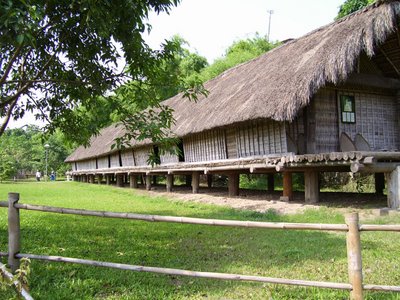
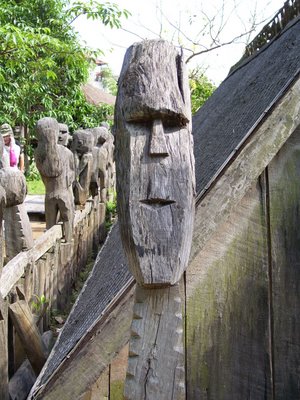
The Vietnam Museum of Ethnology is worth a look.


I have run into several French speakers here in Hanoi, and so I have a new kind of headache from conversations in mixtures of three (instead of the typical two) languages. I like this kind of headache.

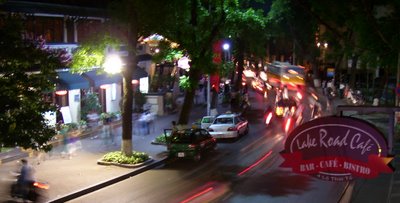
Playing with my camera at night is a sign that I don’t have enough to do.


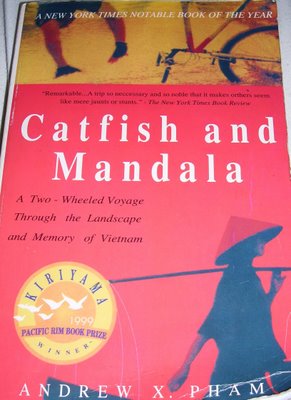
Check out this book. Really good. Character definition reminds me of Steinbeck. I like Steinbeck a lot.


"Saigon traffic is Vietnamese life, a continuous charade of posturing, bluffing, fast moves, tenacity, and surrenders."

"Vietnam is a country of food, a country of skinny people obsessed with eating."

This is a long quote, but I found it way too amusing to resist. Just read it, don’t read into it. This is after the author’s family has migrated to America and is being baptized in the Church that sponsored them.
"I was thinking Grandpa Pham must be looking down on us and smashing his opium pot in fury. I told [my brothers] this meant all our sins were forgiven, but they were jumping up and down, yelling. We’re Americans! I was confused about the whole religion argument. I asked Auntie Dung why Americans go either up or down when they die, but Vietnamese go in a circle. We go up to the sky and stay there for awhile – like Grandpa Pham – to watch over our children, then come back down again for another go on earth. Auntie said you have to believe in one or the other, not both. I said, Huh? But what about this sin thing? Now that we’re Christians, can we really sin and all we have to do is pray for forgiveness and we’re forgiven just like that? Over and over? But if we were just Vietnamese, Mom said we collect our sins like stones in a bucket to be counted when we come full turn on earth again. Auntie said you have to pick one or the other, not both. I said I hope my bucket doesn’t get too full because I don’t want to be reincarnated as a pig and end up skewered on a spit. Auntie said, Don’t be stupid. Still, I felt very lucky to be baptized because it seemed a really good deal."

Friday, March 17, 2006

American Vertigo

With no further blithering on my part, here are some quotes which I found notable. Doesn’t mean I agree with them, only that I found them notable…

On the American view of nature

For a European, one of the most enigmatic characteristics of the American ethos is its relationship with nature.
The Floridians don’t tame nature; they push it back. Instead of subjugating it, they drive it away. Florida is vast, and space is of so much less importance than in Europe, that there’s room for both city and nature.
There are the remains of a pioneering spirit that for centuries has accommodated itself to a sense of temporary habitat, perched, as it were, on the side of the road, pressing forward with the frontier, and by definition precarious.
But there is also, anchored deep in the mentality of the country, a slightly supernatural, almost superstitious relationship to what Americans, even the secular ones, are prone to call Mother Nature. As if omnipotence found its limits there, reached its rational confines.
No pity for our enemies, the American of the twenty-first century seems to be saying; no mercy for terrorist, certainly, or even for opponents of the country’s economic supremacy. But let Nature take her best shot.

On a Colorado ghost town and ‘rooted-ness’

Poetry of these ruins. Beauty of these stranded wrecks from the past.
And beauty, especially, of this people so faintly attached to their roots – beauty, once again, of the prodigious freedom with which they treat their places.

America is the place both of the most extreme uprooting and of the most single-minded territoriality; that it’s the one country in the world where you move, change places, change your home most often, and the one where, at the same time, you remain the most strongly attached to your point of origin and childhood.


On Guantánamo

There are two possibilities. Either we believe that America is at war – in which case these detainees must benefit from prisoner-of-war status and from the protections accorded by the Geneva Convention. Or we subscribe to the End of History, to police treatment – and then all the rights normally granted to prisoners by common law need to be recognized. But this intermediate condition, the fact that Guantánamo’s prisoners, having neither the rights of combatants nor the rights of criminals, finally have no rights at all … I have not heard it denounced clearly enough.

On ‘American Empire’

One is confronted, then, with the extreme unconventionality of a model that gathers its sturdiness both from the conviction among the dominated – including China and India – that it’s in the U.S. banks, the U.S. financial system, and the dollar that the best return on their assets lies, and from the other, linked conviction that the rest of the world must continue to send its elite, its researchers, its future executives, its businessmen, to be trained, until further notice, in American universities, scientific institutions, and companies; in short, this paradoxical system, unique in history and, in reality, extraordinarily fragile, that makes America’s strength dependant on the strength of the confidence that is daily invested in it.

On privatization of the prison system, and the death penalty.

“For me, there’s a before and an after; before I was living like a dog, no one cared about me, but the advantage was that they no longer thought about executing me; today the food is better, the cell is cleaner, but I think they’re going to come looking for me.”
The negative side: the abandonment, when the state resigns and the law of profit reigns, of any kind of reform project. These outcast men – or in this case, women – whom the body politic, and thus the community of citizens, may forget to punish but with whom, at the same time, they have utterly lost contact. This is the height of abandonment.


On the Amish, from Iowa incidentally, not where I come from

The real and final pioneers. The only ones who haven’t given in, haven’t summed up their religion as the “In God We Trust” of banknotes.
The silent witnesses (truly silent, since, unlike the Indians or the blacks, they don’t say anything, don’t demand anything, and, above all, don’t reproach others for anything) – the silent witnesses, then, to the values that were those of America but on which America has turned its back since it sold itself to the religion of commodity.
America’s living bad conscience but, once again, silent.
Just here. We don’t criticize anything. But we are Amish. The profound, hidden, forgotten, denied truth of America is alive in us.

On creationism

There are two theories, and you have a choice: that’s the formula of an enlightened obscurantism; that’s the principle of revisionism with a liberal and tolerant face; that’s the act of faith of a dogmatism reconciled with freedom of speech and though; that’s the subtlest, most underhanded, most cunning, and at bottom most dangerous ideological maneuver of the American right in years.

On religious fundamentalism and secularism

What I reproach these churches for is their banality. It’s their propensity for turning God into some kind of “good guy,” friendly and reassuring, free of problems, watching over a sterile universe, bereft of anguish or negativity. It’s the idea of an insipid God, devoid of mystery, whose aims, although previously impenetrable, are now becoming as familiar as those of a near neighbor or friend.

What, after all, is secularism? It is not, as we know, agnosticism. Nor is it atheism. It is the command given to every state not to favor one faith over another.
France has fought for secularism. It has won its secularism after centuries of confusion and wars of religion. The Americans did not need to separate from anything. The wall of separation, to speak like Jefferson, was raised from the beginning. They were born secular, whereas we French had to become it.

… the compromise negotiated by the Founding Fathers is resisting the slings and arrows of time fairly well – never forget that the God mentioned in the Republican and Democratic conventions, the inaugural speeches, the houses of Congress, is a purposefully abstract God, almost deistic, and at core, consensual, recognized by all American faiths, Christian or not.


Signs of vertigo - Obesity

Another sign: obesity. Not the obesity of bodies, obviously
A social obesity. An economic, financial and political obesity. Obesity of cities. Obesity of malls, as in Minneapolis. Obesity of churches, as in Willow Creek. Obesity of parking lots that, in these malls and churches, sometimes grow so enormous that they generate a full-fledged miniature society, an entire way of life with its own rhythms, spaces, distraction and rest areas, cafeterias, shuttles, even – and this takes the cake – specially organized shuttles so that, once your car is parked, shoppers or worshippers can be loaded into yet another vehicle, thus saving them the trouble of walking.
The obesity of enterprises subject to the law of forced growth … “Greed is good; greed is right; greed works; greed clarifies.”
The bigger it is, the better it is, says America today. Large is beautiful, it repeats over and over in a kind of hysterical reversal of the 1960’s slogan.

A synopsis

…this magnificent, mad country, laboratory of the best and the worst, greedy and modest, at home in the world and self-possessed, puritan and outrageous, facing the future and yet obsessed with its memories…